There I said it. Been sitting on this for some time and it's finally time to say it out loud. Our use of the word 'human' has become dehumanizing.
Hang in there, I will explain.
What's the problem with saying 'human in the loop' or 'humans will always be needed' or 'humans not AIs'? I believe that we are unintentionally heading into a mental trap that carries social and cultural implications. It's dicey territory, not because limiting AI overreach is fraught. (We do need limits like data transparency and much more) No it's dicey, as contemporary culture observer George Lakoff would note, precisely because the word 'human' itself is a frame, an unwitting and unconscious set of conceptual baggage we are bringing along with us.
It's a word we have become hooked on using, that ironically undermines the uplifting goal that the word 'human' aims for. It is supposed to be ennobling. For all humankind. Cue trumpets as Matt Damon lands on Mars and eats his Martian potatoes. But seriously, what I have been noticing, and cringing around for a while now, is that 'human' has started to feel creepy. Not a warm fuzzy caring mother bear word, but an icy cold metallic one. I believe there's a quiet and unintentional side-effect to all this talk of "human" and "ai". In this first piece in my series, I will lay out my case. Agree or disagree. But citizens, lend me your ears.
What I will argue here is that using the word 'human' has at least 3 ill effects. 1) it defines us in the negative, calling out what we are not. 2) worse, it reduces our lovely idiosyncratic menagerie of difference, flattening the conceptual landscape of our shared personhood, and 3) ultimately secures for us the rather dubious role of governor or gatekeeper of a technology that could go off the rails. And, let's be real. How much longer will our governorship last? You think AI won't do a better job at keeping us safer than the air traffic controller last week who nearly brought two Southwest Airlines into a midair fireball because his automated systems lulled him into a mis-read on a situation? Yes, there is real danger with AI on a lot of levels. It's why we need to integrate and adapt to this new world safely and in as measured a pace as we can. But odd as it sounds, I think a very real danger we are not giving enough attention to is the little semantic frame trap we are laying for ourselves as we buy into a false dichotomy that might just be our undoing.
Faster Than We Think
This is something new and different. We never used to say the word "human" like we do now. We said person. People. Team. Colleague. Sarah. The folks in marketing. These words carry social identity: roles, relationships, names, histories, accountability. They situate someone in a web of meaning.
And without really noticing, I think we have let "human" become our default self-description in professional contexts. Human-in-the-loop. Human oversight. Human judgment. Human-centered AI. Not people. Not persons. Humans. Just gut check it right there. What's the difference you feel when you hear 'human' and when you hear 'person'. One is a species in the Kingdom Animalia. The other has a name. Is a rock star, or a mountain climber, or a burglar or an axe murderer. Yes, we have a little of everything to offer. More mountain climbers than axe murderers thankfully.
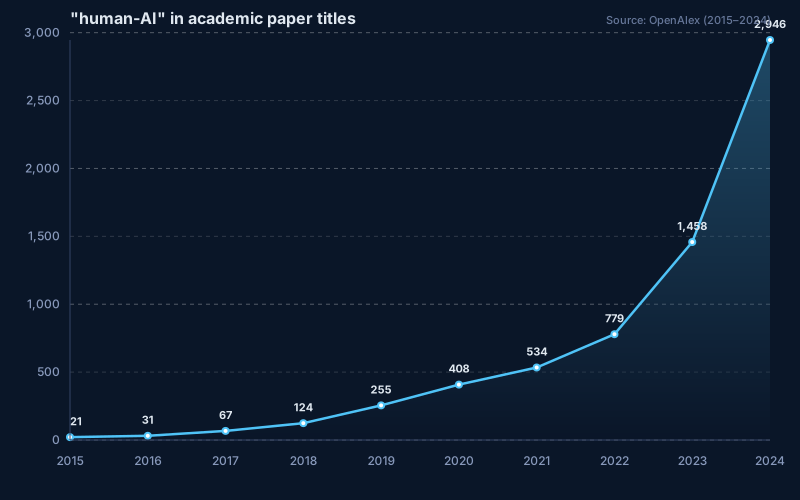
Just to put a little data in the conversation, I consulted OpenAlex, one of the world's large collection of academic research and did number crunching on the rise in papers using human vs ai framing between the years 2020 to Present.
Unintended Consequence
"Human" draws a boundary between us and everything else in the ecosystem. In the age of AI, it seems with the existential talk all around us, we almost sense a new species being realtime brought into the ecosystem of life. And maybe it is, we don't know yet. For some this is the horrifying thought that maybe we will not always be the apex predator. Those particular folks go down a dystopian rabbit hole. Tech utopians on the other hand, share something in common with the dystopians - they also have their own way of seeing in a species level endgame. Ray Kurzweil recognizes the new AI species being born, can't wait for the singularity to come fast enough, and just like his dystopian brothers, sees us in a competition with something not us. But this boundary between us and it (whatever it is), is the point. Both sides are framing the situation the same way - humans and ai. That's their shared identity claim.
This gets to what has been nagging at me when I hear the word 'human' used incessantly, often by well intentioned people. It's that when your primary self-description is a negation, you've already ceded the frame. You're defining yourself by what you aren't. I am a non-fish. Technically true. Utterly uninformative about what I actually am or what I can do.
People have identities. We have driver's licenses, certifications, passports, families and pets. We have names you call across a meeting table, or over the bar after work. We have histories, communities we work in, particular skills that took decades to build. We bring a philosophy degree to the prompt, or twenty years of facilitation practice, or a deep intuition for organizational politics lived in our bones.
Constantly calling out "humans", I feel the word is demeaning us, reducing us to some goo that you spread onto your business process or your powerpoint. Put a little human in it for me. It's losing its heritage of people-centered richness. We are becoming lost in a binary. Human = NOT Machine. This is actually a semantic demotion, an ontological emasculation, disguised as an ennobling promotion. Don't fall for it.
Who's Loop Anyway?
Creativity theorist, Dr. Lorenzo Magnani argues that cognitive possibilities (fresh ideas) depend on the affordances available in our environment. Our language is part of that environment. It's one of the most powerful cognitive spaces we inhabit. And when "human-in-the-loop" becomes the standard phrase (and frame) it already constructs a very specific affordance. Look at the architecture it is constructed upon. First, there is a loop. It belongs to a mechanical system. You are placed in it. You're a component. Point is, the agentic machine has the process, the flow, the agency. We get to be a checkpoint. You get to approve or reject. You hit either '1' or '2' in Claude Code. (do you ever do otherwise?)
If our noble role is to keep hitting the approve or disapprove button, offering occasional inputs while the system does most of the real work, if that's de-facto what "human-in-the-loop" is starting to look like (and there are many signs that is the case) then human-in-the-loop looks a lot like a person slowly becoming an automaton.
Now, try a thought experiment, make a substitution. Try saying "People-in-the-loop." It's a small shift. We're still in the machine's space but it's different. For one, people is plural, and evokes images of a team. Suddenly the loop might be ours. The locus of agency might shift. We could be "a team on a journey letting AI in when we choose to." Now in that case, there's no loop at all. We do loop and we reify and center the team and their outcomes. That suggests a group of specific people with specific capabilities making decisions. A very different cognitive affordance, built from a different set of words, which are as we said above, different frames of reference.
id est / exempli gratia
There are two Latin abbreviations that capture two fundamentally different ways of thinking and framing. id est, abbreviated "i.e.", literally "that is" and exempli gratia, literally "for example."
Id est functions by reducing the shades and nuances of a topic of conversation to some singular point or definition. This can be a helpful clarification. When a colleague is going on and can't quite explain themselves, you might say, "in others words Bill, you mean X?". Bill might be relieved or annoyed. Some Bills like to talk. Some appreciate a simplification or a reduction. Either way, id est does the semantic work of compression. This is an LLM super power by the way - compression. Want to save some money on your API token burn, inject your LLM system prompt with 'always use extreme semantic economy'. It works! Hat tip to Hamid Ennachat for that one.
With 'exempli gratia', we have an enumeration. A listing of items that might fit into one cognitive frame or not. We have to do a little sensemaking to find out. So we talk. This is when Bill has tried making his point while assuming you know what 'that is' but you can't quite put your finger on it. So you start thinking of examples to see if that's what he means. Used this way, 'e.g.' opens into multiplicity, into cases and instances and variation.
Both moves are important, both vital to innovation and to really any healthy conversation which has the potential to go somewhere new, some place of clarity and fresh insight. The two work together really well. So usefully in fact it's probably why we turned them into abbreviations. If I can't give you exempli gratia of my wild new idea, you won't be able to help me nail it with a clever id est. I might say, "It's like patients and doctors working in a messed up centralized system and I want to connect them somehow." And you come back with, "So, you're really talking about the Uber of healthcare here". Yes! or Sort of, or No, but let me go further. And the dialog turns again.
Why am I going on about this arcane Latin grammar and its role in conversation and by extension, innovation. Because "Human vs. AI" is, whether we realize it or not, the ultimate id est. It's a claim on our identity as people. This binary opposition makes it quite clear there are no variations or shades amongst us, just one category and it's not machine, it's human. Almost sounds like humus, which is delicious, but equally undifferentiated. In that semantic frame we really are Sartre's other. We 'other' ourselves by constantly setting ourselves against this thing called AI. It collapses a universe of personhood, a mix of saints and sinners, wild card thinkers and data driven analyst, into a single axis of differentiation. Not AI.
Innovation Buzzkill
People, not humans do great things. Great in the Harry Potter sense. Like in that scene in Diagon Alley when Mr Levender hands Harry the Voldemort's style wand and says "Oh, yes... he-who-shall-not-be-named did GREAT things, but TERRIBLE things!" Everything that really matters - in innovation, in leadership, in organizational growth - begins with specific people doing specific things, exempli gratia, even if at first they are barely understood. We are the blind men feeling the different sides of the elephant naming its different parts, until a coherent picture forms. It always starts with a hunch, a maybe, a hmmm, or a huh. We explore the hunch space in a dialog, either with ourself or with a friend/colleague. Specificity brings color, sparks connections, opens new mental frames and spaces. That is the world of exempli gratia and id est, at their best, in a mobius loop like up and down and over again flow.
You are envisioning some customer and some value proposition that might delight. To make it real, to come alive, you name this person with this background who would love this outcome. Maybe you engage these hunches with a teammate, one who is quite unlike you, in temperament and outlook. That other human, this lovely person, might be one who helps you see this pattern that you haven't put a name on yet, but she does with a powerful id est. You two nail the innovation concept and decide to pitch it to this particular leadership team which has these particular trust dynamics. But luckily, you know that this particular leader heading up the meeting has an Enneagram style and DiSC which means she can hold tension long enough with us to prevent anyone from jumping to premature conclusions.
Flatland
When everyone defaults to AI and everyone has the same models at their fingertips, a flattening happens. By the way, all of our recent public binary conversation about human vs ai has been fed back into the models' training, reinforcing this binary into their neural networks. It may be a statistical engine churning out the next likely token one after the other, but a billion parameter hyperspace trained on human vs ai binaries increases the statistical likelihood of hearing this phrase again and again. A strange loop indeed.
The person who brings a philosophy degree to the LLM has a fundamentally different experience than the marketing major or the editor. The leader with twenty years of pattern recognition brings something a junior analyst with the same tools cannot. By the way, the junior analyst brings something awesome too, fresh eyes. Reducing everyone to "human" makes all the differences invisible at exactly the moment they matter most, to all of us.
This is where it gets serious for anyone who cares about innovation.
Creative abduction, the logic of generating new hypotheses, works by drawing on the particular. It pulls from who you are, what you've experienced, what you uniquely bring, the real-world context you inhabit. It's the move that says: given everything I know and everything I've lived, here's a possibility nobody has considered yet.
But "human" doesn't draw on any of that. It has no particular 'particulars' at all. It gives you no material to reason from except the bare fact of not being artificial. That's not a foundation for creative thought. That's a foundation for anxiety.
For abduction to work, especially the creative, theoretical, and manipulative kinds that drive real innovation, you need to be a person with a history, not a "human" with a pulse. The word choice matters because it shapes whether you approach a problem as a unique cognitive agent or as a generic biological validator.
What Changes If We Stop Saying 'Human'
Nothing right away. The world keeps spinning. Swap a word. Big deal. But check your gut. You know what I'm getting at here. How does it feel to say 'person' or 'team' the next time you talk about AI. See what happens when you try this switch for a week with your team. What shifts?
At Jedi On The Fly, our AI-augmented innovation consultancy I co-founded, we intentionally avoid the human/ai binary. Our motto is not fine-tuned models but fine-tuned teams. This semantic shift is a small discipline, and at first it might grate on the ear. The 3rd person plural "they" has come into use for non gender-specific pronouns. It still lands odd on the ear for me, but I respect it. I get the shift it's making. I'll posit that "people-in-the-loop" sounds wrong simply because the alternative has become so entrenched. But this discipline matters because language shapes thought, and thought shapes what we build, in a double loop cycle.
If our mental model is "AI does the work, humans approve it," then humanity (in the largest sense) will build approval systems, checkpoints and dashboards where someone clicks Accept. On the other hand, if our model is "a team of specific people with specific capabilities leads a process, augmented by AI tools," then you'll build something different, I guarantee it. Because, you'll build for the particular for the idiosyncratic, for the 'freakies' as they say in Spain. You will talk and argue and debate and ultimately design for the person who sees what others miss. For the conversation where differences get aired and shaped. For the alignment that only happens when real individuals with real stakes sit in a room and do the hard work of deciding together.
Jeff Bezos famously distinguished Type 1 and Type 2 decisions. Type 2 decisions are operational and reversible, the kind AI can make, fail at, and remake. Type 1 decisions are foundational bets, irreversible or nearly so. Do we partner with this firm? Do we reorganize? Do we invest in this technology? Type 1 decisions require System 2 thinking: slow, deliberate, multiperspectival. They require rich conversations where differences surface and get shaped. They require the kind of alignment that only happens between people, not between "humans" and machines.
Decision bottlenecks will always be people. Beautiful and frustrating as that may be. The superpower of the future firm isn't AI capability. It's the capacity to hold real conversations where AI gets a seat at the table, but that's it. Language belongs to people. Not humans. People.
I find it most interesting that right now, surrounded by slop, genAI shit music, and autotuned Top 10s, into the world comes something so fresh and freaky and new, and yes, I'll allow myself to say it, so human. In the deep sense of responding to a felt crisis in the environment, the ecosystem (the wasteland of modern music), two people felt an upwelling and acted on their own idiosyncratic Quebecquoise Quirky initiative to create a nearly indescribable something new in the music landscape. If you haven't heard of them yet. As the kids say on TikTok, they're blowing up right now. And getting audience reactions of sheer delight. These two fellas followed a hunch and their own set of live experiences to almost craft a new genre. Some call it Math Rock. I might say DaDa poetry meets prog meets punk. But what do you call this? People at their best. Check out Angine Du Poitrine when you have a minute.